
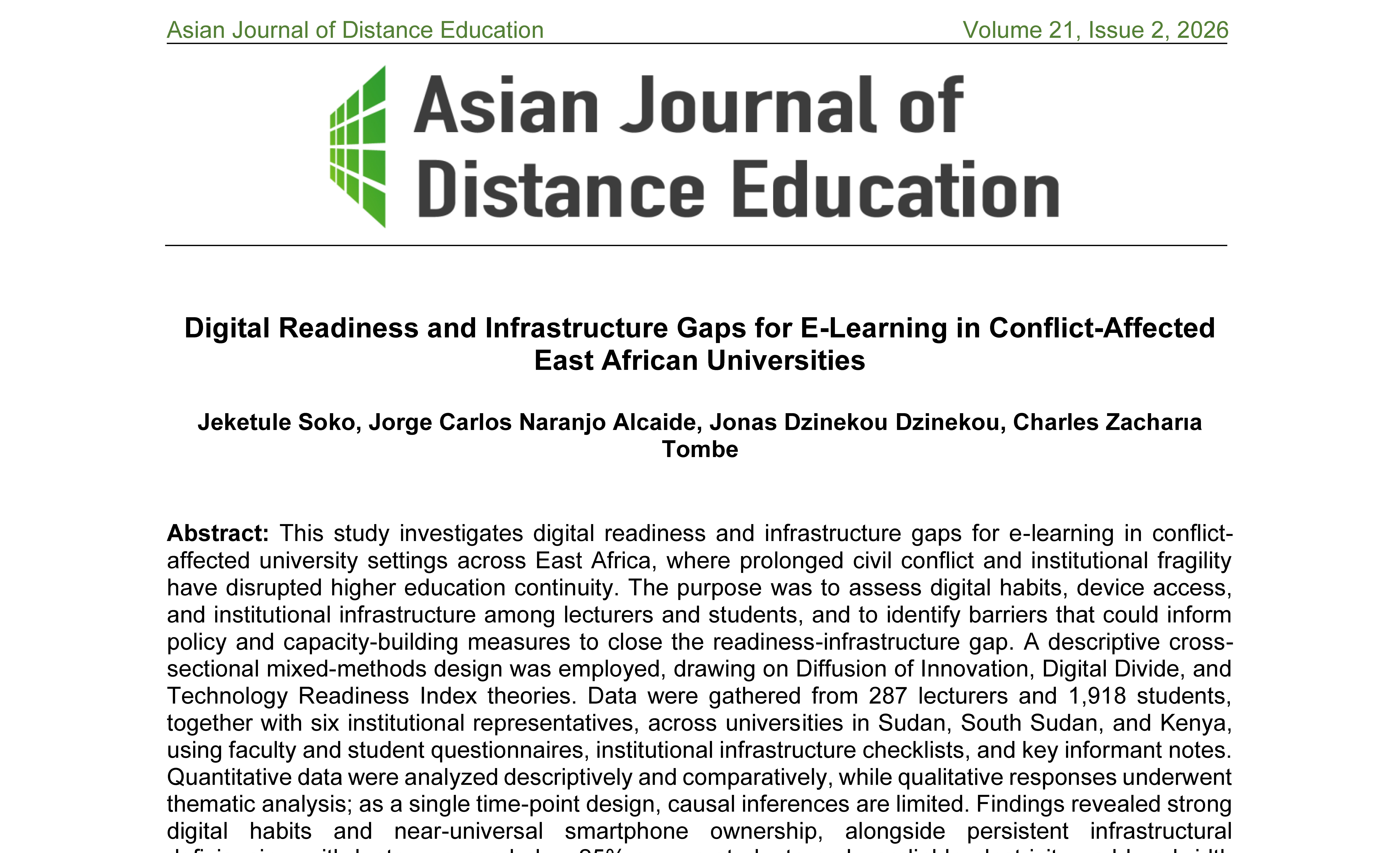
The EAGLE project has reached another important dissemination milestone with the publication of the article “Digital Readiness and Infrastructure Gaps for E-Learning in Conflict-Affected East African Universities“ in the Asian Journal of Distance Education. The paper was authored by Jeketule Soko (Tangaza University), Jorge Carlos Naranjo Alcaide (Comboni College of Science and Technology), Jonas Dzinekou Dzinekou (Tangaza University), and Charles Zacharia Tombe (St. Mary’s College, South Sudan), and presents research developed within the framework of the project.
The study analyses the results of the EAGLE Work Package 1 (WP1) baseline assessment, which collected data from 287 lecturers, 1,918 students, and institutional representatives across partner universities in Kenya, Sudan, and South Sudan. Using a mixed-methods approach, the research evaluates digital habits, access to devices, institutional infrastructure, and the main barriers affecting the implementation of e-learning in conflict-affected higher education institutions.
The findings reveal a clear “readiness–infrastructure gap”: while lecturers and students show high levels of digital readiness and widespread smartphone use, institutional infrastructure (including reliable electricity, internet connectivity, ICT equipment, and Learning Management Systems (LMS)) remains insufficient to fully support sustainable online education. The study highlights the importance of investing in resilient digital infrastructure, institutional policies, and mobile-friendly learning solutions to strengthen higher education in fragile contexts.
This publication represents an important dissemination outcome for the EAGLE project, contributing scientific evidence that supports its mission to strengthen digital transformation and improve the resilience of higher education systems in conflict-affected regions of East Africa.