
| ACTIVITY | YEAR 1 | YEAR 2 | YEAR 3 | |||||||||
|---|---|---|---|---|---|---|---|---|---|---|---|---|
| Q1 | Q2 | Q3 | Q4 | Q1 | Q2 | Q3 | Q4 | Q1 | Q2 | Q3 | Q4 | |
| WP1. Identification and development of infrastructure solutions | ||||||||||||
| 1.1. Verification of the actual situation of universities for internet access | ||||||||||||
| 1.2. To propose an efficient solution for accessibility to internet | ||||||||||||
| 1.3. Training for satellite connection for local technicians | ||||||||||||
The first task of the proyect was to assess the current situation of students, lecturers and universities regarding the access to internet, the available infrastructures in information technologies, and the experience in delivering e-learning courses. For this assessment, three different questionnaires (for IT teams and Administration, lecturers, and students) were prepared and distributed among 287 lecturers, 1918 students and IT responsible persons from the six partner universities:
As part of this task, Deliverable 1.2 – The Questionnaire Report was produced, analyzing and summarizing the results of three comprehensive surveys conducted among students, lecturers, and IT administrators. The report highlighted key challenges such as limited internet bandwidth, insufficient digital skills, and infrastructural disparities across institutions, while also identifying significant opportunities for targeted improvements in connectivity, training, and the use of Learning Management Systems.
The project developed and successfully delivered a series of hybrid technical trainings aimed at strengthening the IT capacities of partner universities. The sessions, held in Nairobi in May 2025, focused on WiFi deployment, network infrastructure for online education, and the installation, configuration, and administration of Moodle-based e-learning platforms. These trainings equipped local technicians and academic staff with the skills required to install, maintain, and troubleshoot connectivity systems, ensuring stable and resilient access to online learning resources.

Following the on-site activities, the IT coordinators and technical teams from all partner universities continued meeting online in the following months to discuss implementation challenges, share solutions, and consolidate a common strategy for improving digital connectivity and e-learning support across institutions.
| ACTIVITY | YEAR 1 | YEAR 2 | YEAR 3 | |||||||||
|---|---|---|---|---|---|---|---|---|---|---|---|---|
| Q1 | Q2 | Q3 | Q4 | Q1 | Q2 | Q3 | Q4 | Q1 | Q2 | Q3 | Q4 | |
| WP2. Development of e-learning structures | ||||||||||||
| 2.1. Establishing a strategy for internet access for lecturers and students | ||||||||||||
| 2.2. Deployment of hardware to host e-learning platforms at universities | ||||||||||||
The project is implementing a comprehensive strategy to improve internet connectivity for lecturers and students across partner universities in Kenya, Sudan, and South Sudan. The assessment revealed major differences in bandwidth, infrastructure, and human resources among institutions, with South Sudanese and Sudanese universities facing the most critical limitations. To address these disparities, the strategy combines fiber-optic expansion, Wi-Fi upgrades, and hybrid connectivity models that integrate mobile networks and satellite internet to ensure reliable access to Learning Management Systems (LMS) such as Moodle.
Mobile phones, widely available even in remote regions, play a central role in enabling flexible access to educational content, while satellite connections such as Starlink complement existing infrastructures in areas lacking mobile or terrestrial coverage. The plan also includes capacity building for IT staff and the creation of redundant backup systems to enhance resilience. Through this integrated approach, the project is ensuring inclusive, stable, and sustainable digital connectivity to support effective online teaching and learning.
The project is investing in the implementation of Moodle, an open-source Learning Management System (LMS), at each partner university to improve digital education capabilities. Moodle’s flexibility and scalability make it suitable for meeting diverse academic and technical needs.
Each local partner has prepared a detailed list of the equipment and infrastructure needed to host and maintain the platform, including servers with multi-core processors, 64 GB of RAM, and 2 TB of SSD in RAID 1. Scalable solutions, such as additional servers, are also being considered for larger universities or those planning future expansion. This coordinated approach is ensuring reliable LMS functionality and stable online learning environments across all partner institutions.
| ACTIVITY | YEAR 1 | YEAR 2 | YEAR 3 | |||||||||
|---|---|---|---|---|---|---|---|---|---|---|---|---|
| Q1 | Q2 | Q3 | Q4 | Q1 | Q2 | Q3 | Q4 | Q1 | Q2 | Q3 | Q4 | |
| WP3. Tunning of a common e-learning platform | ||||||||||||
| 3.1. Installing and running the e-learning platform | ||||||||||||
| 3.2. Creation of virtual e-learning centers and e-learning tools (LMS) | ||||||||||||
Based on a needs analysis and local realities, UNIC, UPV, and African partners will evaluate existing infrastructure, networks, and IT systems in partner countries to develop a collaborative plan for implementing an e-learning platform. The plan will involve local technical and academic staff, providing training in Cyprus and Spain to ensure effective installation and administration of systems. Four options will be considered:
- A unified system for each university or country, offering simplicity but risking mismatched needs.
- Bespoke systems tailored to each institution, providing flexibility but increasing complexity.
- A shared platform for all partners, which is easier to manage but limits scalability and knowledge transfer.
- Access to European partners’ Moodle platforms, as a last resort, with minimal knowledge transfer.
Local staff will receive customized training in Europe and Africa, emphasizing hands-on knowledge transfer. Collaboration between European and African teams will ensure the platforms are well-suited to the educational and technical needs of each institution. The project aims to empower local partners, fostering long-term independence in managing and developing e-learning systems.
Virtual e-learning centers and LMS managing centers will be established based on the chosen system for each country and university. These centers will handle program and course administration, manage access, create course structures, and support faculty in developing synchronous and asynchronous learning content. Tailored training, including hands-on sessions, will be provided to partner country staff in Europe and Africa. European and African teams will collaborate closely to build and optimize these centers, ensuring effective knowledge transfer and empowering local staff to manage and sustain the e-learning infrastructure independently.
| ACTIVITY | YEAR 1 | YEAR 2 | YEAR 3 | |||||||||
|---|---|---|---|---|---|---|---|---|---|---|---|---|
| Q1 | Q2 | Q3 | Q4 | Q1 | Q2 | Q3 | Q4 | Q1 | Q2 | Q3 | Q4 | |
| WP4. Training local teachers and technicians | ||||||||||||
| 4.1. Training in e-learning platform and materials | ||||||||||||
| 4.2. New teaching methods and quality control and assessment for e-learning | ||||||||||||
Two types of training will be offered to African teachers and technical staff at European universities to develop skills in creating e-courses and e-learning materials:
UNIC in Nicosia is providing a two-part technical training on setting up and administering an e-learning platform. The first part of the course was successfully delivered in Nairobi in May 2025, focusing on Moodle fundamentals, e-learning methodologies, and practical workshops on course structure and interactive tools. The second part will take place at the University of Nicosia, deepening participants’ knowledge on advanced Moodle administration, assessment design, and digital content development. African participants will collaborate with experts in IT system maintenance and online course administration. Read the complete news about the training in Nairobi.

UPV will deliver a tailored workshop covering course preparation, recording lectures, transitioning from lecturer to facilitator, student assessment methodologies, and virtual tutoring and coaching. Training will emphasize practical skills, including recording educational materials in UPV studios, ensuring participants can create and manage engaging e-learning experiences.
This comprehensive training will prepare participants to implement effective e-learning platforms and materials in their home institutions.
Experts from UPV and UNIC will train African educators in online teaching methods and quality control of e-learning aligned with European Bologna standards. The workshop will include practical exercises, interactive activities, and real case studies, ensuring participants gain hands-on experience in implementing effective e-learning practices.
| ACTIVITY | YEAR 1 | YEAR 2 | YEAR 3 | |||||||||
|---|---|---|---|---|---|---|---|---|---|---|---|---|
| Q1 | Q2 | Q3 | Q4 | Q1 | Q2 | Q3 | Q4 | Q1 | Q2 | Q3 | Q4 | |
| WP5. Creating e-learning educational modules and piloting | ||||||||||||
| 5.1. Structuring the modules | ||||||||||||
| 5.2. Configuration and production of educational materials | ||||||||||||
| 5.3. Piloting the modules | ||||||||||||
With support from UNIC and UPV, East African universities will design at least two online courses per institution, each with a minimum of 3 ECTS. Local teachers will define syllabi, structure content for Moodle, and design evaluation methods, receiving expert feedback to align with EU university standards.
Educational materials for the online courses will be developed under the guidance of European universities, using training from Valencia and Nicosia. Topics will be carefully chosen to ensure applicability across partner universities, enabling broad delivery, achieving a multiplier effect, and ensuring cost efficiency for the project’s outcomes.
Partner universities will pilot the e-learning modules during the project’s final year. UPV and UNIC will evaluate their structure, materials, and delivery, providing feedback for improvement. These modules will advance digitalization and introduce transversal topics. Piloting activities, including meetings, workshops, and reports, will occur online and offline for skill transfer.
| ACTIVITY | YEAR 1 | YEAR 2 | YEAR 3 | |||||||||
|---|---|---|---|---|---|---|---|---|---|---|---|---|
| Q1 | Q2 | Q3 | Q4 | Q1 | Q2 | Q3 | Q4 | Q1 | Q2 | Q3 | Q4 | |
| WP6. Quality control and management | ||||||||||||
| 6.1 Kick-off meeting | ||||||||||||
| 6.2 Creation of Quality Assessment and Risk plan | ||||||||||||
| 6.3 Project management meetings | ||||||||||||
| 6.4 External evaluation | ||||||||||||
The Kick-off Meeting was held at Tangaza University College (TUC) in Nairobi, Kenya, on May 20–21, 2025, marking the official launch of the project. Representatives from all partner institutions attended both in person and online, including universities from Kenya, Sudan, South Sudan, Cyprus, and Spain.
The sessions focused on financial management, project coordination, and the review of work packages, outlining the deliverables completed and those scheduled for the following months. Key topics included budget transfers, consortium agreements, equipment acquisition plans, quality control, and dissemination activities.
👉🏽 Read the complete news here.


The Quality Assessment and Risk Management Plan was developed to ensure a systematic evaluation of the EAGLE project’s effectiveness and to guide continuous improvement throughout its implementation. A Quality Committee, composed of one representative from each partner country (Spain, Cyprus, Kenya, Sudan, and South Sudan), was established following the Kick-off Meeting. This committee defined the procedures, templates, and indicators to monitor progress, assess deliverables, and evaluate the consistency of results with the project’s objectives.
The plan set out the roles and responsibilities of all partners, ensuring that quality control became an integral part of project management:
- Regular monitoring reports, mid-term evaluations, and satisfaction surveys will be conducted after each training or meeting to measure participants’ engagement and the practical impact of project activities.
- Both internal and external evaluation mechanisms will be used: internal monitoring will be coordinated by UPV as Work Package Leader, while an external evaluator will be appointed to provide independent assessments and recommendations to the Steering Committee.
In addition, a Risk Management Plan was included to identify, classify, and monitor potential risks affecting implementation. A detailed Risk Matrix and Risk Register were developed to evaluate probability and impact, covering issues such as partner communication, financial management, mobility disruptions due to instability, and technological challenges. Mitigation strategies included regular online coordination meetings, transparent financial oversight, and contingency planning to ensure project continuity even in unstable contexts.
The Management Committee, with representatives from all partners and led by the coordinator, will oversee project operations through consensus-based decisions. Key principles include fluid communication, active participation, technical efficiency, cost-effectiveness, and transparency. Four in-situ meetings will align with other project activities, allocating an extra day for management discussions. Work Package leaders will present reports, review completed tasks, and plan upcoming activities. Draft minutes, including deadlines, will be approved by all partners. Online videoconferences will supplement annual meetings, addressing urgent management issues and ensuring efficient communication for project success.
- PPM 1 – Celebrated online on January 16, 2025.

- PPM 2 – Celebrated online on May 13, 2025.
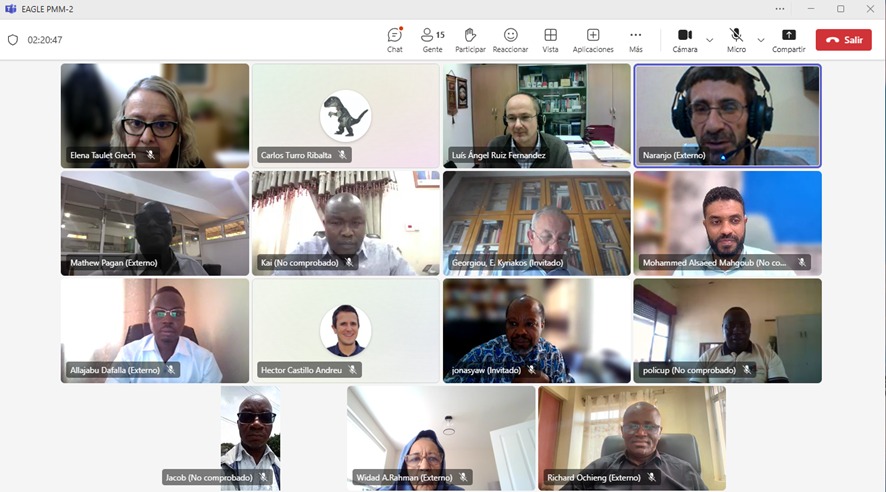
- PPM 3 – Celebrated online on July 9, 2025.
An independent expert will evaluate the project from year two to its conclusion, meeting key stakeholders, visiting Kenyan e-learning laboratories, and analyzing online module development and quality assurance. Two reports will be issued: an interim report with recommendations and a final evaluation. This complements institutional and national-level assessments.
| ACTIVITY | YEAR 1 | YEAR 2 | YEAR 3 | |||||||||
|---|---|---|---|---|---|---|---|---|---|---|---|---|
| Q1 | Q2 | Q3 | Q4 | Q1 | Q2 | Q3 | Q4 | Q1 | Q2 | Q3 | Q4 | |
| WP7. Creation of a legal platform for online programs in South Sudan | ||||||||||||
| 7.1 Workshop: Standard practices for a legal framework for online programs | ||||||||||||
| 7.2 Creation of a draft legal document | ||||||||||||
A one-day workshop will educate stakeholders on developing a legal framework for online education in South Sudan. Topics include EU practices, insights from Sudan and Kenya, and key considerations for online education. Government representatives, legal experts, educators, and students will participate. The workshop aims to enhance awareness, promote stakeholder collaboration, and provide actionable steps for crafting a framework tailored to South Sudan. The Ministry of Higher Education, Science and Technology (MHESS), an associate partner, will contribute to discussions and conclusions, ensuring alignment with national needs and international best practices.
A comprehensive legal framework for online education in South Sudan was developed through a Committee composed of legal experts, government representatives, and higher education stakeholders. Collaboration with an external expert ensured that international best practices were incorporated throughout the drafting process. The framework was informed by research on European standards and the experiences of Sudan and Kenya, adapted to the specific context and needs of South Sudan.
Several iterations of the draft were produced to ensure alignment with national educational priorities, legal traditions, and stakeholder feedback. The Ministry of Higher Education, Science and Technology (MHESS) guided the process and will be the main beneficiary of the framework. The resulting document comprehensively addresses quality assurance, accreditation, access, and international compliance, and has been completed and is currently awaiting official signature by the Ministry.
| ACTIVITY | YEAR 1 | YEAR 2 | YEAR 3 | |||||||||
|---|---|---|---|---|---|---|---|---|---|---|---|---|
| Q1 | Q2 | Q3 | Q4 | Q1 | Q2 | Q3 | Q4 | Q1 | Q2 | Q3 | Q4 | |
| WP8. Dissemination and exploitation | ||||||||||||
| 8.1 Creation and maintenance of website and social networks | ||||||||||||
| 8.2 Promoting online modules | ||||||||||||
| 8.3 Final dissemination conference | ||||||||||||
A official website has been developed by the project coordinator (UPV) to serve as the main communication and dissemination portal of the EAGLE project: https://eagle.webs.upv.es/
In addition, TUC created project accounts of the following social networks:
Promoting the project’s goals, activities, and results is key to ensuring sustainability and public engagement. In addition to websites and social networks, the project will produce reports, brochures, videos, and e-booklets about the online modules and activities. Opening ceremonies for e-learning Labs in Kenya will coincide with other project activities (e.g., management meetings, workshops) to ensure cost-efficiency. Promotional efforts will also include workshops and training sessions from WP4. All partners will participate in dissemination tasks, encouraging student involvement and sharing results with professionals in geoinformation and related fields. These activities aim to broaden the project’s reach and enhance its long-term impact and sustainability.
Promoting activities:
- Comboni College of Science and Technology (CCST) organized a dissemination webinar in Port Sudan to introduce the EAGLE project to its academic community, with the participation of ambassadors, government representatives, and partner institutions. The event highlighted the relevance of the project in supporting Sudanese universities amidst ongoing conflict, emphasizing its role in enabling academic continuity through digital transformation. Read the news here!
- Prof. Luis Ángel Ruiz, coordinator of the EAGLE project from the Universitat Politècnica de València (UPV), participated as a speaker in the Erasmus+ Stakeholder Meeting – Fostering Peace through Inclusive and Sustainable Exchanges held online on October 16, 2025. During his presentation, he introduced the main objectives and early outcomes of the project, emphasizing the importance of digital learning infrastructures as tools for inclusion and resilience in regions affected by conflict. The event, organized by the European Commission and the Erasmus+ National Focal Points Network (ENFP), brought together stakeholders from around the world to discuss how education and technology contribute to peace and sustainable development. Read the news here!
The final conference in Nairobi, organized by TUC, will present project results to university staff, students, industry professionals, administration bodies, and mass media. It will highlight the project’s sustainability and societal benefits, fostering future collaborations between partners, local, and international stakeholders, and linking with other capacity-building projects.